
 The daffodils have come and gone, and the lilac buds are trying hard to open on the lawn of the Oceanic Hotel. A troupe of naturalists is set to arrive in a few days to chronicle the annual bird migration through the Isles of Shoals. Sugarloaf ski area closed a week ago, releasing my attention until the snow flies again in November. And it’s launching time again.
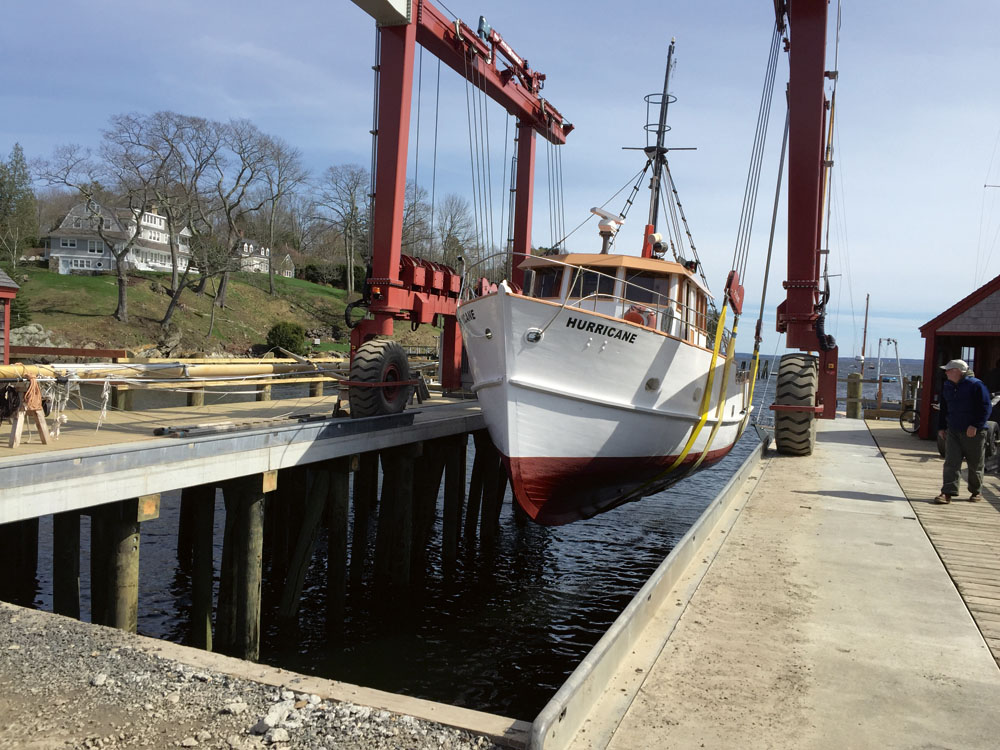
I’m just back from the rechristening and partially successful delivery of m/v Hurricane to Portsmouth from Mount Desert Island. Hurricane is old and wooden, loaded with character and history. Designed and built as a supply and crew vessel to service the Hurricane Island Outward Bound School, she hit the cold harbor at the Hinckley Yard in Southwest Harbor last week with bilge pumps blazing – a mile from where she was first launched in 1967.
Hurricane is bound to Gosport for a new life of service at the Shoals. Both the Coast Guard and last November’s survey say she is structurally sound (while still in need of paint, polish and a lot of love). My old friend Catboat Bob, veteran of many a cruise and not a few misadventures, says that her addition to the fleet is final proof that I’ve lost my mind.
In spite of our best efforts to anticipate and prevent surprises, launching a wooden boat presents a litany of potential problems, the results of which can range from mere inconvenience to full-blown catastrophe. In the case of Hurricane’s recent launch and a weeklong soak at a quiet dock, a delightful run from Southwest Harbor to Rockland proved her seakeeping ability in six-foot beam seas.
We cruised through familiar sailing grounds: out by the Western Way, over the Bass Harbor Bar, through Casco Passage and Deer Isle Thorofare, across East Penobscot Bay – bisecting Vinalhaven and North Haven – and finally crossing West Penobscot Bay (almost keeping up with the state ferry), to slip triumphantly past the breakwater into Rockland Harbor.
When secured at the protected float at Journey’s End Marina, we shut the engine down after the first hard run the boat had seen in 10 seasons. But our satisfaction was immediately complicated by the sound of a steady cascade of water spewing from the area of the stuffing box below the main deck. We plugged her in to shore power and raised the hatch to have a look.
While most of the seams were only weeping, water was fairly pouring from around the deadwood, into the sump below the shaft. Two of the four big hanger bolts, which secure the stuffing box to the sandwich of oak timbers above the keel, had sheared off, allowing the bronze flange to break its tentative seal, and, thus, welcoming the eager waters of the harbor into the bilge.
Two of the six pumps were running almost continuously. A T-shirt carefully caulked into the gap with a putty knife stemmed the flow enough to reduce the pump cycles to about three minutes. The crew repaired to a tavern to lick their wounds. Disaster was still only a failed bilge pump away, and sleep was hard to come by that night.
I was awakened before dawn by the sound of the voices of two fishermen idling by on a nearby lobsterboat. “Look at that old girl. Some kind of trawler, maybe?”
“She’s all wood, looks like. At least her pumps are running.”
“I guess they better be, by the looks of her.”
After a while, the staff began to arrive at the boat yard. I went into the office where a kind-faced receptionist asked if she could help. “I need a little miracle,” I replied. She said that might be expensive, but pointed me in the direction of the yard manager just the same.
Upon hearing our plight, Doug Woodbury told me, with what looked like real concern in his eyes, that he would not be able to help us. To make matters worse, he needed our berth for another boat within an hour. Before my heart had a chance to begin racing at full rpm, he added that he knew who could help us, and promptly made a call to Charlie Conlan at Rockport Marine.
Charlie told me he would be happy to help. Based on my description of the problem, he felt confident that he could fix things up pretty easily. But the fix would require a haul-out. “If you can steam over here, we’ll get you plugged in and haul you out within a few hours.”
Charlie met us at the float with the yard owner, Taylor Allen. They couldn’t have been more accommodating, and actually seemed happy to see us in company with the salty, old Hurricane. The yard specializes in the building and repair of classic wooden yachts and working vessels, many of them much larger than Hurricane. In spite of a busy spring schedule, they took us in and went right to work. I had found my miracle.
That’s often the way it goes at the beginning of a season. I remember the initial trip in our first sailboat, a 17-foot O’Day. We launched her at the ramp in Rye Harbor, N.H., on a blustery June morning. This was early in my sailing career, and there were big gaps in my appreciation of the fundamentals. We paddled to the float and raised the mainsail with her transom to the wind. After lowering the centerboard and securing the tiller in its bracket, I took a deep breath and released the last line holding us by the stern. The boat surged ahead with a mouthful of wind, nearly planing across the crowded low-tide harbor toward the flats inside the jetties.
To my intrepid wife’s relief, the centerboard soon struck the rising bottom, snapping the cable with a pop. Continuing the mad surge downwind, we grounded out shortly in the thick, gray mud. Crestfallen, I lowered the main, hopped into the ooze, and dragged the boat back to the ramp. The first voyage had lasted but a few long minutes, and my relieved wife was smiling again. On the way home I stopped at a convenience store and bought a magazine with an article titled “Avoiding the Top Ten Sailing Mistakes.”
And then there was the July launch of our wooden sloop Hopestill at Badger’s Island Marina some time in the 1980s. Launching a wooden boat after a month in the summer sun, I learned, is asking for trouble. As the trailer slid her down the ramp and the water rose up along her sides, the boottop disappeared below the Piscataqua tide. Even after a few minutes of soaking and pumping, she still refused to rise. The river was sloshing over the cockpit sole. The launch was thus aborted, and the trailer retreated back up the ramp.
Copious amounts of Slick Seam were hastily applied to the seams. On the second attempt she floated at last. But the 1500-gph pump alone proved insufficient to stem the tide. The answer was the frantic deployment of the world’s best bilge pump (a scared man with a bucket). Just when I thought I couldn’t bail any more, a stranger appeared with a gas-powered sump pump.
After a few hours, Hopestill remembered how to float on her own again, and I spent a happy night aboard with the increasingly intermittent whine of the pump to keep me company. A week later we were sailing.
I often say that the Unitarian Star Island Conference Center runs not on prayers, but on a series of loosely connected miracles. The guests will be here all too soon. And we will finish all the projects, fill the cistern, stabilize the wastewater treatment plant, make the beds, and get the rocking chairs set up on the porch – just in time, as always. The same goes for these boats. As experience grows, luck becomes less of a factor. But a well-timed miracle is always welcome now and again.
Jack is a USCG 100-ton master and the facilities director at Star Island at the Isles of Shoals, where Aloft lives most of the summer. Formerly island manager, Jack now focuses on running freight boats and tours during the summer season and managing the waterfront.


 We have complete issues archived to 2009. You can read them for free by following this link.
