
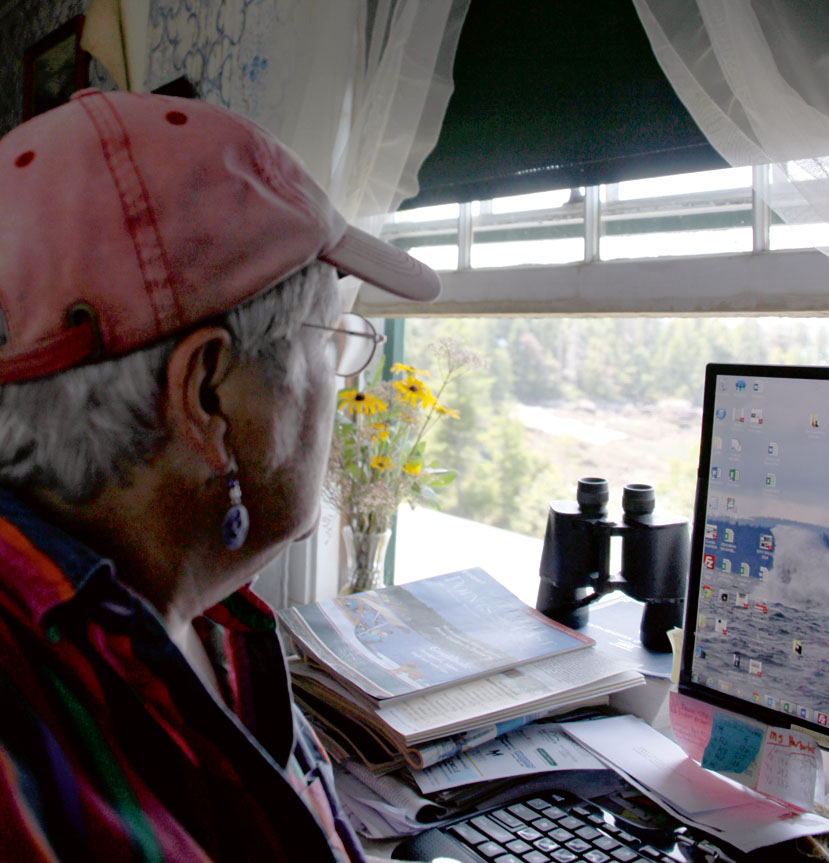
 The sea captain’s wife looked to the east and then to the west from her home on the serpentine cut between the islands of Vinalhaven and North Haven, Maine. In the summer months, particularly, this was her world, and the nature of the commercial traffic that plied this waterway told her much about the rest of the world on the mainland.
As was her wont this brisk and cloudless day in early autumn, she waited for commercial traffic to pass through, trusting that vessels would tell their stories by the nature of their cargos and the directions of their passage.
“Sitting at my second-story perch,” she wrote in the precise prose one might expect from an educated, 19th- or early 20th-century island woman, “I can observe traffic approaching the Fox Island Thorofare from Young’s Point at the western end, progressing past the North Haven anchorage, then taking the turn at Grindstone Ledge, and through the narrow passage between North Haven’s Iron Point and Zeke Point on the Vinalhaven shore.”
Instinctively, her practiced eyes caught movement near the western end of the passage. Soon, it was evident that she was looking at a pair of vessels that, from their labored bearings, appeared to be carrying heavy loads. As they got closer, she could see that one of the vessels was “way-low in the water, loaded with a huge pile of boulders.”
Was this one of the little schooners carrying granite east, from a Muscle Ridge quarry to Deer Isle? These small stone freighters were known to load more rock than they should on their midships decks, which were often re-rigged to lengthen the cargo area between mainmast and foremast.
“I have seen the Annie and Reuben with something over 200 tons of stone aboard, lying at Crotch Island wharf with the water flowing through the scuppers to the height of an inch or more on the main hatch coaming,” wrote John Leavitt in his book “Wake of the Coasters.” “This in a flat calm.”
But this wasn’t the Annie and Reuben, or the Lewis R. French, or any of the other stone freighters of a century or more ago. The two vessels were a Prock Marine tug and barge. And our Watcher at the Thorofare, high in her aerie, was not a sea captain’s wife whose time on earth had come full-circle 100 years ago. She is, rather, Lynn Whitney, a captain’s wife who is Points East’s Maine ad rep and clearinghouse of coastal skinny. Her husband Vid was skipper of sail-training vessels on both sides of the Atlantic, including the 103-foot schooner Spirit of Massachusetts.
“This year, there were multiple trips of a Prock Marine tug and barge loaded with boulders,” said Lynn. “After watching the third trip through, my inquiring mind got the best of me, and I called to find out where all this stone was headed, and it was to Southwest Harbor, for a ‘rubble-mound breakwater’ at Dysart’s Great Harbor Marina.”
“As the fall progresses in the Fox Island Thorofare, a few intrepid cruisers, mixed with boat deliveries, are easily outnumbered by commercial vessels: lobsterboats, the O’Hara fishing fleet, the herring carrier Jacob Pike, and Rockland Marine’s Island Transporter,” Lynn continued. “This really caught my eye, as it didn’t appear to be supplies for a stone pier, which would include a tender and other materials and a more orderly pile of rocks. The fact that the pair came back through just to repeat the process within days was also evidence that it was a drop-off-and-repeat routine.”
How lucky is Points East to have a Watcher at the Thorofare!


 We have complete issues archived to 2009. You can read them for free by following this link.
