
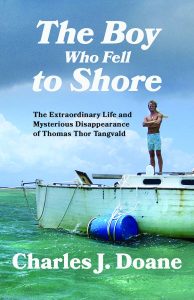
In The Boy Who Fell to Shore: The Extraordinary Life and Mysterious Disappearance of Thomas Thor Tangvald
By Charles J. Doane, Lata Books, 2022, 298 pp, $19.95
May 2023
By Tim Murphy
When I was a kid and circumnavigators were gods, Per (“Peter”) Tangvald was a Titan. He was the hero our heroes revered. In 1957 Tangvald won the first-ever singlehanded transatlantic race, then sailed around the world and in 1966 published Sea Gypsy, the book that influenced so many aspiring voyagers in that great midcentury expansion of the cruising world. Lin and Larry Pardey dedicated their 1982 book “The Self-Sufficient Sailor” to him.
 Tangvald’s boats were always of wood, not thermosetting plastic, and he rebuilt and rerigged them often. He sailed with no engine; he eschewed all onboard electricity. No depth sounder on his boat, only a lead line; no digital navigation instruments, only a sextant and compass. Also, no VHF radio, no incandescent lights, no automatic bilge pump. When the Pardeys said, “Go small, go now,” Tangvald’s message was more ascetic still: accept nothing on your boat that you yourself cannot repair. It was a message that resonated deeply in those countercultural 1960s and ’70s – in our hearts if not on our actual boats. In that emerging tribe of cruising sailors, Per Tangvald was an elder whose example set down our early cultural benchmarks.
Charlie Doane, one of our tribe’s great chroniclers working today, has taken a deeper look at the man and the legend – and particularly at the heavy costs Per Tangvald’s single-minded dream extracted from the flesh-and-blood women and children who loved him. Those costs, it turns out, were devastating.
In “The Boy Who Fell to Shore: The Extraordinary Life and Mysterious Disappearance of Thomas Thor Tangvald” (https://www.latahbooks.com/blank-1/the-boy-who-fell-to-shore), Doane brings his focus to the next Tangvald generation, particularly to Per’s son Thomas, born at sea and seldom of any fixed address in his lifetime, which spanned little more than three decades. In fact, the son’s life eerily reprised the father’s. Doane’s book opens with the heart-racing story of Per’s final shipwreck off Bonaire in 1991–a disaster from which Thomas, age 15, alone survived but not before witnessing the haunting death of his father and 7-year-old sister. By many accounts young Thomas, with scant formal education, was a prodigy: a boy who designed his own working sextant at age 10 and who in less than one year completed two years of prep work that landed him a university scholarship in physics and mathematics. Doane’s story follows Thomas through his own sea-gypsying aboard simple wooden boats to his final days before setting off from South America in 2014 on a passage from which he never returned. Between those two presumed shipwrecks runs an exquisitely reported psychodrama. It’s impossible to avert our gaze. Or to suspend our judgment.
In “The Sea Is Not Full” (Seapoint Book, 2017), Doane deftly profiled other influential elders of the cruising culture (Don Street Jr., Jimmy Cornell) and quirky outliers (Reid Stowe, Poppa Neutrino). Together with his “Dead Guys” series of obituaries at www.wavetrain.net (James Wharram, Tim Severin, Larry Pardey, Edward Allcard, et al), Doane’s body of work, in a voice that consistently mixes iconoclasm and reverence, is emerging as one of our culture’s best-told histories.
“The Boy Who Fell to Shore” is at once a ripping-good sea story, a captivating family profile, and a sober reflection on the values we sailors carry in our hearts.
Tim Murphy is a “Cruising World” editor-at-large who lives in Portsmouth, Rhode Island and cruises aboard Billy Pilgrim, a 1988 Passport 40.


 We have complete issues archived to 2009. You can read them for free by following this link.
