
We are not going to attempt to create a buoy-by-buoy cruising guide but I’d like to share with you the basic path to follow. It corresponds with the chart photo included in the article.
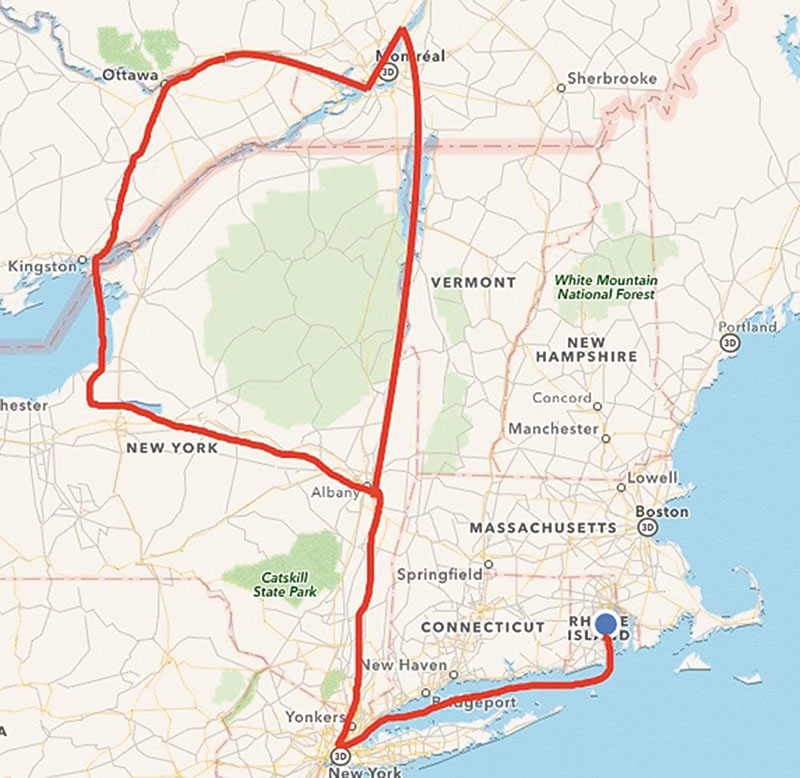 Leave Narragansett Bay at Point Judith and head west toward Watch Hill Passage and into Long Island Sound. Time your passage carefully through Hell Gate and the East River. Travel down the East River and turn north at The Battery, heading up the Hudson River. After the commercial area and north of the George Washington Bridge and Tappan Zee Bridge Construction, the Hudson becomes very scenic – nice cruising grounds.
At Troy, N.Y., you will meet your first lock. This is the Federal Lock, and, although it is not numbered, it is the first lock to enter the New York Canal system. From the Federal Lock, head north a short ways, and you will come to a junction of the Erie and the Champlain canals. Head west to Waterford and the start of the Erie Canal.
You will enter a flight of five locks here at Waterford, so be ready with lots of fenders and gloves to handle the lines. You will have a simple canal cruise for many scenic miles – just follow the buoys. After Rome N.Y., you will be getting ready to cross Lake Oneida, which can get a little snotty. Look for good weather and leave early: The westerly wind will kick up a short, nasty chop and some real waves.
On the western side of Oneida, you arrive in the lovely town of Brewerton, with every marine repair and supply facility you could ever need. Leaving Brewerton and heading west, you will arrive at the junction of the Oswego Canal, which will take you north to the City of Oswego and the south side of Lake Ontario. This is another place to watch your weather and plan your departure to cross the lake to Kingston, Ontario. We took a little detour up into the Thousand Islands, and stopped in Sackets Harbor.
Kingston is a lovely city and a very good place to clear into Canadian Customs and Immigration – by phone. Kingston is worth a visit to several museums and many fine restaurants. After Kingston the most beautiful part of the journey awaits you as you enter the Rideau Canal, heading toward Ottawa.
As you begin the Rideau Canal, your first set of locks is at Kings Mills. This set of locks is similar to most you will experience until you reach Ottawa. All the locks along the way are UNESCO World Heritage sites, and each is worth docking at and exploring. Your time, however, might not allow that, which is unfortunate.
In Ottawa, you are at the top of the kite-shaped journey. Here you will have the opportunity to tie to the city wall and look up at the Parliament Building before you descend the eight-lock flight down to the Ottawa River.
Navigating the Ottawa River is straightforward, but follow the markers and look for the middle: It is not very deep outside the channel in some areas. On the Ottawa River, you will enter the Carillon Lock. The 85-foot drop as you get lowered to the next level of the river is a delight. You will continue a few more miles until you approach Sainte Ann De Bellevue. This is the last lock on the Ottawa River and the last port before Montréal.
You have several choices here about visiting Montréal. You can take a train or a bus into the city. We did not stop in Montréal but rather chose to enter the St. Lawrence Seaway and proceed eastward through two Seaway locks.
When you approach the Seaway locks, you tie off to a waiting-area dock, call on the phone provided, and inform the lockmaster that you wish to transit. The lockmaster will advise you as to the wait time and the cost.
The trip up the St. Lawrence will have current up to Sorel; of course, it will be to your advantage to travel with the current. A couple of marinas are in Sorel, which is a good layover before starting down to Lake Champlain. Your trip down to Lake Champlain will bring you through three different canals, all just one connected together: the Richelieu, St. Chambly and Ours.
You will arrive back in the U.S. at Rouses Point, N.Y., where you must report to Customs and Immigration. There is a dock with a simple straightforward approach. The Customs agents will even help you with lines if they see you coming. A few good marinas are just to starboard after the bridge: Gains Marina has U.S. fuel prices and full services.
Lake Champlain is beautiful, but its holding-tank requirements are the strictest I’ve ever encountered. The law says you must disable any ability to pump sewage overboard. This means disconnecting the hoses between tank and overboard discharge.
In Whitehall, you will have a free wall, with electricity, for the evening on the other side of the locks. You are now in the N.Y. State Canal system, and when you pass through the last lock – the Federal Lock at Troy – you will be backtracking down the tail of your kite.
Resources for the Kite Loop
Guides:
- “Down East Circle Route by Cheryl Barr, www.yachtpilot.ca.
- “Cruising the New York Canal System” by Skipper Bob Publications, www.skipperbob.net.
- “Cruising the Rideau & Richelieu Canals” by Skipper Bob Publications, www.skipperbob.net.
- The Great Circle Route by Skipper Bob Publications, www.skipperbob.net.
Rideau Canal Information:
- rideaucalan-info@ps.gc.ca.
- “Cruising Guide to the Hudson River, Lake Champlain & the St. Lawrence River” by Alan and Susan McKibben, www.lakechamplainpub.com.
- “The Cruising Guide To The New York State Canal System, Champlain, Erie, Oswego, Cayuga, Seneca,” publicinfo@thruway.state.ny.us.
- “Boaters Resources” by N.Y. State Canal Corporation www.canals.ny.gov.
Charts:
- Rideau Canal, “Ottawa to Smiths Falls, Chart No. 1512,” Small Craft Nautical Chart, Canadian Hydrographical Service.
- “Rideau Canal, Smith Falls to Kingston, Chart No.1513,” Small Craft Nautical Chart, Canadian Hydrographical Service.
- Canadan Hydrographical Service. Nautical Charts and Publications, Catalogue No. 1, Atlantic Coast. www.charts.gc.ca.
- “Lake Champlain. Trak Maps Nautical Chart Book No. 105, www.trakmaps.com.
- The Navionics US and Canada chart chip on my Raymarine MFD was invaluable.Jim and Dede McGuire
 We have complete issues archived to 2009. You can read them for free by following this link.
