
September 2024
By Angus Kerr
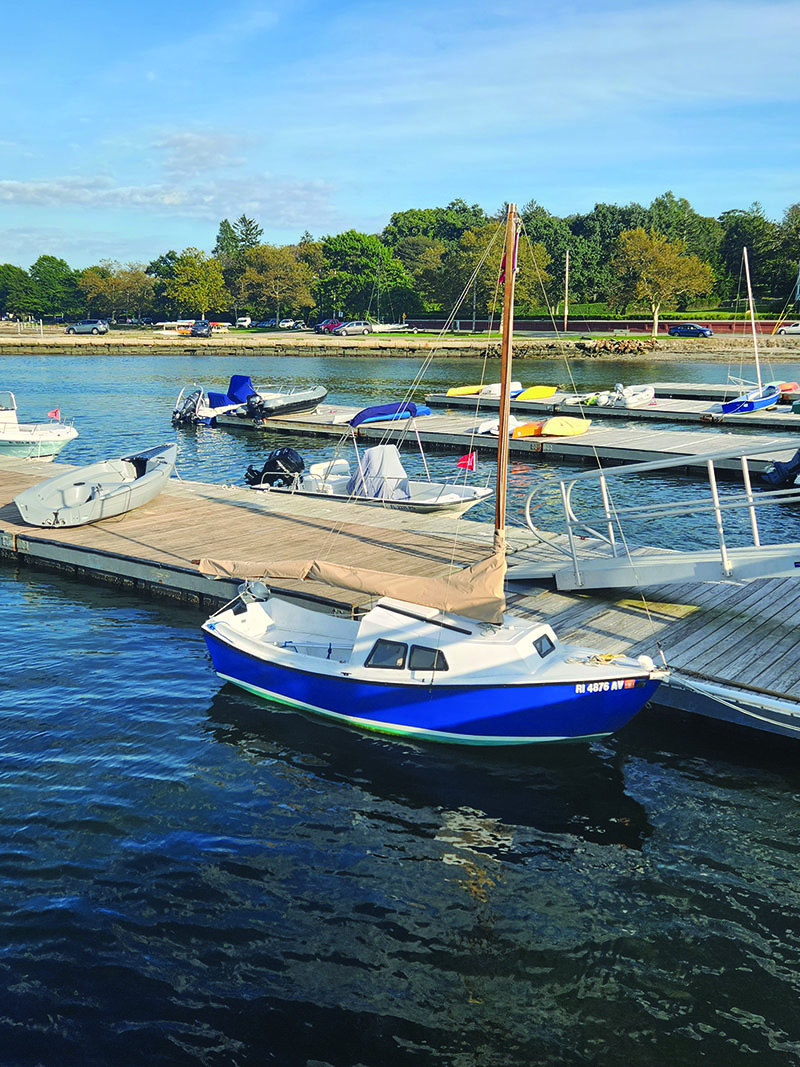
The author’s West Wight Potter is 14-feet long, can carry a small outboard and sports a cuddy cabin that has two bunks. Photo courtesy Angus Kerr
It was the early spring of 2019 when I got the call. After 10 years, my name had finally reached the top of the waiting list for dock space at the Ida Lewis Yacht Club. After a decade of waiting, I now had a place to keep a boat in Newport, Rhode Island, “The sailing capital of the world.” There was just one problem, and it was a big one: I didn’t own a boat! What to do?
I got on the phone and called every sailor I knew. “Do you know where I can get a cheap sailboat? It can’t be longer than 16 feet, because that’s the limit on the space.”
In metaphysics, they say, “When the need is there, the teacher appears.” This must hold true with boats, too. My good friend, and skipper of our J/22 race team, James Powell, said, “Why don’t you take mine?”
James’ boat was no ordinary vessel. It was an original West Wight Potter. The boat was only 14 feet long, but within that small frame, it held an incredible history. The West White Potter (WWP) was designed in 1960 by Stanley Smith. Mr. Smith had made headlines by crossing the Atlantic not once, but twice, in a small sloop. In 1960, he planned to do it again in a 14-foot boat!
Stanley was a third generation boat builder from the western tip of England’s Isle of Wight. Hence the name West Wight. As for the Potter, that came from English slang. “Potting around” meant loitering about, meandering, cruising, with no particular place to go.
Stanley wanted a boat that could be towed by a small-engined, subcompact vehicle. In his case, a Morris Minor. He also wanted his new design to fit in his garage. It also had to be capable of being single-handed across the North Atlantic.
What he came up with was the first West Wight Potter. The original was made of wood. Later models, like my 1971, were made of fiberglass with wooden trim. It was 14 feet long, with a beam of 5’ 3”. It weighed 540 pounds and displaced just shy of 549 pounds. The sail area was 87 square feet, but even in modest winds it could go 3 to 5 knots. Many owners, including myself, put a 2- to 3-hp outboard on it. The WWP has a centerboard, so the draft ranges from six inches to three feet. Yes, if you pull the centerboard up, you can actually bring the boat right up on the beach. It has almost 75 lbs of ballast. (According to the old fliers, 74.96 to be exact.) Since mine is one of the older, original models – sail number 391, to be exact – it is gunter rigged. Later models went to a Bermuda rig.
The cabin is far forward to prevent water from splashing back into the cockpit. Inside are two 6’3” bunks with three portals for lots of light. Is it comfortable? With an overhead of about 4’ 6”, you can not stand in it, unless the hatch is open. However, I’ve slept on mine, and it was pretty cozy. A canvas tent over the cockpit greatly expands the living space.
I’ve only ever sailed in and around Narragansett Bay on my WWP, but others have made some incredible journeys aboard theirs. The designer, Stanley Smith, for example. He never made that trip across the Atlantic, but he did deliver a WWP to an owner in northern Sweden by sea. Yes, he sailed his WWP from the Isle of Wight, through the English Channel, across the North Sea to Sweden. And he did it in gale force winds and waves! Others have sailed WWPs from Los Angeles to Hawaii. For a little boat, they do get around.
This is one of the reasons the WWP is so popular. While mine still has the HMS registry plaque on the inside of the transom, the design was sold in 1975 to a company in California. They made a lot of modifications, like introducing a 19-foot version, and adding a foot to the smaller model. The original, gunter-rigged 14 was a different boat and it is no longer made. According to Wikipedia, 2,600 West Wight Potter 15’s have been made. To own one is to own a piece of maritime history. Unfortunately, my WWP 14 needed a lot of work.
The owner previous to me, James, had gotten the boat from his uncle, who sailed it on the Great Lakes. It was based in Lake Erie, in New York. Its name was Wisp, and James put a lot of work into it, including stripping and sanding down the original red hull and repainting it a dark blue. He sailed it on the Sakonnet River, the easternmost portion of Narragansett Bay. James enjoyed many a sunset sail, but with three kids in school, investment portfolios to manage, and a love for racing his J/22, little Wisp got neglected. Well, not entirely. An adventurous raccoon found her way under the tarp and made a comfortable den in the cabin. I told you the interior was cozy.
The man who taught me to sail, Matt Cohen, also restores boats. So, I called him up and asked him what he might be able to do. Matt promptly looked the boat over and said, “I can do the work, but it would take me most of the summer. Why don’t you use it this season as-is?” Which is what I did. My wife renamed the boat Imari, after our cat. We sailed around that summer, but never made it across the bay to Jamestown, our goal. As I said, the boat needed a lot of work!
Eventually, Matt did completely restore Imari, but by then my health was such that I had to make the painful decision to give her up. She is currently for sale. All I ask is that she gets a good home, with an owner who will love and appreciate her wonderful history.
Angus Kerr is a retired NYC special-education teacher who comes from an old New York/Rhode Island family with a long history of sailing. He and his wife, Tomoko, currently sail out of the Ida Lewis Yacht Club in Newport, R.I. However, time has caught up with Angus, and he is currently looking to find Imari a new home.


 We have complete issues archived to 2009. You can read them for free by following this link.
