
 You know those little 61⁄2- by 91⁄4-inch, soft-cover books with the sepia-toned covers, the ones that recycle old postcards and photographs to give readers a window into how specific areas appeared during the past 100-plus years? They are called the Postcard History Series Books, are produced by Arcadia Publishers, with offices in Charleston, S.C., Chicago, Ill., San Francisco, Calif., and Portsmouth, N.H., and they are found in most New England bookstores and souvenir shops.
We have one entitled “Narragansett Bay,” and we love to pore over it, finding the dramatic changes in harbors, yacht clubs, fashions, modes of transportation, and commercial and recreational vessel designs in the coastal villages we know.
A few weeks ago, we received a review copy from a new generation of Arcadia publications – hard-cover, but still sepia-toned, with marbled endpapers, faux decorative spine tape, replete with index and bibliography. One of their Images of America Series, this 128-page volume is called “Boston Light,” by Sally R. Snowman and James G. Thomson, and it was due to be released Aug. 22 this summer.
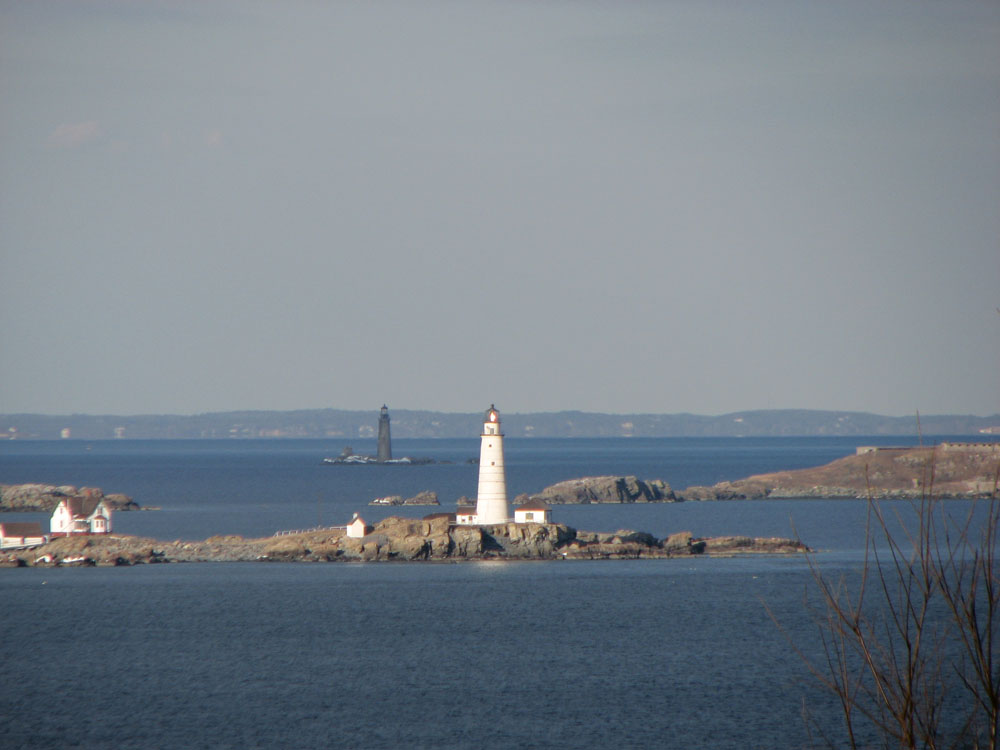
What timing! On Sept. 14, the station of Boston Light, on Little Brewster Island in Boston Harbor, will celebrate its tercentennial — 300 years of withstanding, with its crews, the pummeling of vicious hurricanes and nor’easters, blinding blizzards and ice storms, and three centuries of guiding mariners around the rocks, islands and ledges of the outer harbor. On that date in 1716, at sunset, the original tower of Boston Light was first lit by keeper Capt. George Worthylake. The lantern, the “Boston Light” authors write, “is described as a semi-opaque glass lens housed in a wooden frame, illuminated by ordinary household candles or possible oil lamps.”
We shot the photo above on Feb. 10, 2006, the very first image we took with a new digital camera. At the time, we had no clue that this lighthouse was the oldest such navigation aid in the country, as well as the last manned U.S. Coast Guard light station in America. And, obviously, we knew not that this structure would, in a decade, be 300 years old.
Then two things happened: Within three months, we received the review copy of “Boston Light,” and then Sue Cornell submitted an interview with Eric Jay Dolin, author of “Brilliant Beacons: A History of the American Lighthouse,” a different and complementary lighthouse book, also released this year. This interview, which imposes new dimensions on these guardians of our shores, appears in the Media column on page 68.
“Beginning with Boston Light, America’s first lighthouse,” Dolin tells Sue, “‘Brilliant Beacons’ shows how the story of America, from colony to regional backwater, to fledging nation, and, eventually, to global industrial power, can be illustrated through its lighthouses.”
When Boston Light was first illuminated, Founding Father George Washington, born in 1731, would not be even a twinkle in his father Augustine’s eye for another dozen years or so. In 1716, North America’s 13 colonies could probably count less than 300,000 inhabitants. We find all this quite mind-boggling, and we bet you will, too. So check out these two books and grasp the true wonder and significance of our coastal beacons.


 We have complete issues archived to 2009. You can read them for free by following this link.
