
Ask New Englanders where and when North America’s first colony was established, and most will likely say Jamestown, Va., in 1607. Jamestown’s claim may be true – in a tenuous way: Records tell us that Maine’s Popham Colony was also settled that year, near the mouth of the Kennebec River.
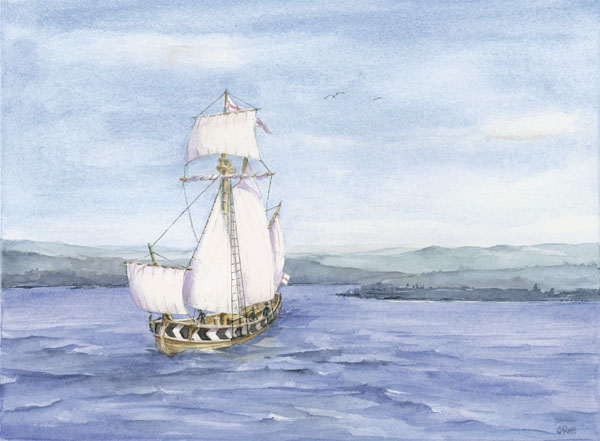 Sure, the Jamestown Colony was chartered the year before, in 1606, and, established in April 1607, and, yes, the Popham Colony, which lasted only 14 months, was settled a scant four months later. But the two outposts were created in 1607 – Maine’s to support Virginia’s. Lest you’ve forgotten, that’s 13 years before the Mayflower landed in Plymouth, Mass.
Perhaps a greater source of pride for New Englanders is that the Popham Colony built the first North American vessel to cross the Atlantic. Thousands of American-built, ocean-crossing vessels have been built over the past 408 years, yet the first to cross the pond was built in what would ultimately become Maine. And a group called Maine’s First Ship (MFS, www.mfship.org), in Bath, Maine, is building a replica of that vessel, the 51-foot, 37-tun pinnace Virginia. Tun?
“In 1607, a ‘tun’ represented, as it does today, a barrel holding 252 gallons of wine,” wrote John W. Bradford in his analysis of the original vessel, “The 1607 Popham Colony’s Pinnace Virginia: An In-Context Design of Maine’s First Ship” (2011, $26.95). “The size of a 17th-century vessel was expressed in ‘tuns’ or ‘tunnes’ of capacity . . . .”
A 51-foot ship? “To purists, calling our Virginia a ‘ship’ stretches this term’s definition as much in the 17th century as in ours,” Bradford wrote. “On the other hand, there is no question that she capably performed the duties of a small ship with her two transatlantic crossings.”
In form, however, Virginia was very much a pinnace, “Light enough for limited maneuvering by oar if that need arose . . . a hull design that yielded a relatively fast and lightly constructed, shallow-draft support vessel [fishing, trading, exploring, and cargo carrying] with a distinctive square or flat transom,” Bradford explained. Virginia is said to have had two rigs: a coastal rig and a deep-sea rig. Plain sail for the former was spritsail and headsail; for the latter, square main course and larger topsail – the “modified barke rig” seen in the painting at left.
Virginia’s specifications were hardly imposing: The original was roughly “30 tuns burthen,” 50 feet LOD (length on deck), with a 14-foot, six-inch beam and a six-foot, six-inch draft (fully loaded). She had a flush main deck, and, Bradford wrote, less than two feet of freeboard. Today, cruising couples girdle the world in more formidable seaboats. Yet the Virginia crossed the Atlantic at least twice, transporting colonists from Maine to England, including a trip back to Virginia to support the Jamestown colony during the 1609 famine.
Castine, Maine, naval architect David B. Wyman developed the replica’s working design from data collected by Fred M. Walker and Associates of England. Input was provided by Capt. Steve Cobb, shipwright Rob Stevens, and, of course, historian John Bradford.
Virginia is being built with the support, resources and energy of Maine’s First Ship members, sponsors, contributors, volunteers, and summer student boatbuilding programs. The replica is being built to USCG Standards for Small Passenger Vessels, and her future will include Maine “floating-classroom” cruises and longer passages to historic East Coast shipbuilding sites.
This year’s plan has been to plank up the hull, and install deck beams, knees and decking. Virginia’s shipyard (Bath Freight Shed 27, 31 Commercial St., Bath, Maine) is open year-round. Check the MFS website for days and hours.
MFS describes its purpose as, “to memorialize the efforts of those who built Virginia, the first English ship built in North America to cross the Atlantic.” By building a new Virginia, MFS also will be honoring Maine’s tradition of shipbuilding, with some 4,000 vessels built on the Kennebec alone. And this, me hearties, is where the story of Virginia all began.

 We have complete issues archived to 2009. You can read them for free by following this link.
